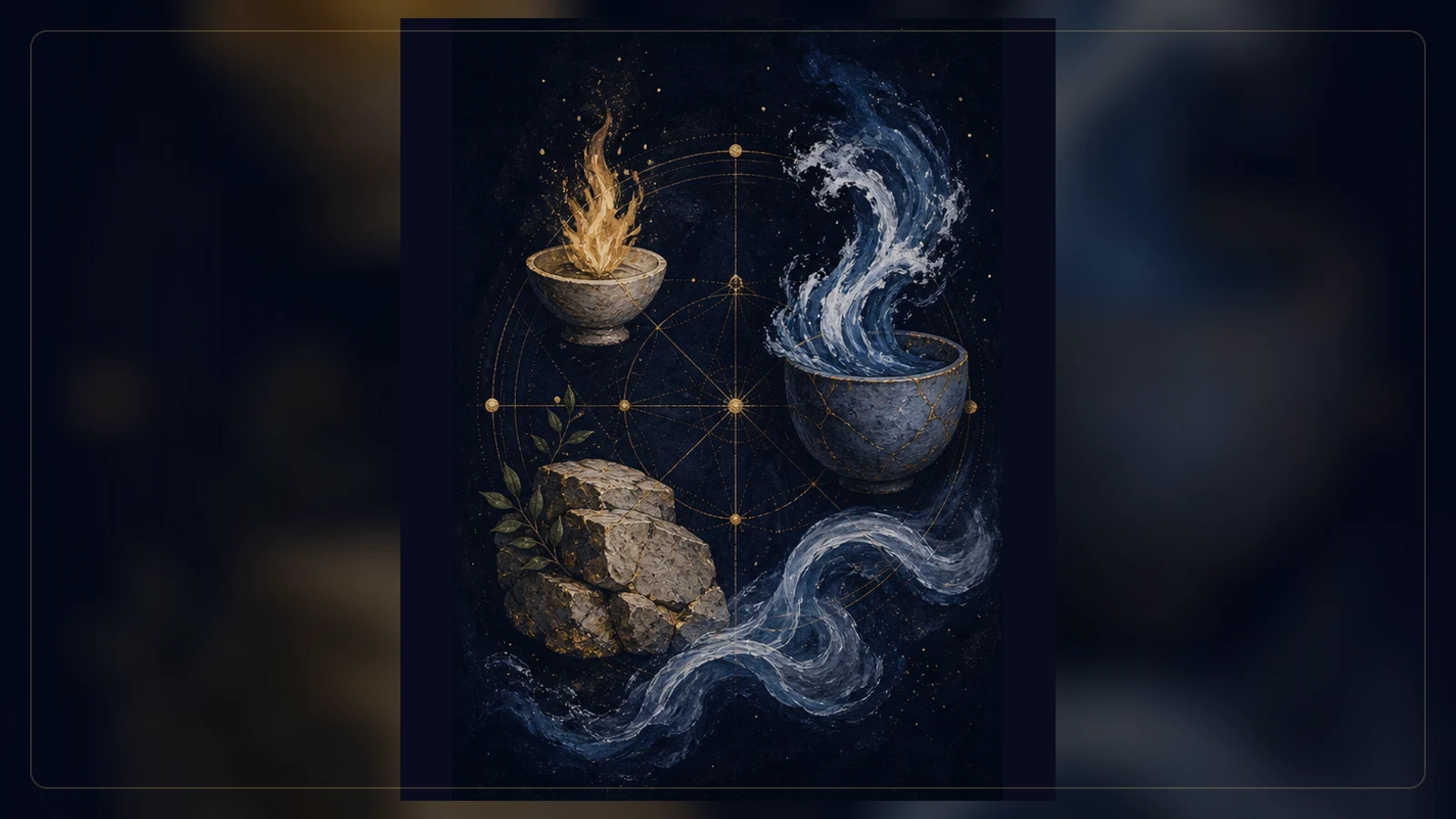
Before you read any single placement, there is a cruder measurement that often says more: the count. Take the eight points a chart tracks — Sun through Saturn, plus the Ascendant — and sort them into four bins: fire, earth, air, water. The distribution is the chart's climate. Some charts are rainforest, some are high desert, and the difference shows up in everything from how you argue to why your to-do lists die.
A climate is not a verdict. It tells you which kinds of energy are cheap for you and which have to be imported — and imported energy is not worse, only more expensive. Knowing your own price list is the point.
Four elements, four contributions
Fire (Aries, Leo, Sagittarius) is ignition: initiative, appetite, the willingness to act before the evidence is complete. Fire placements answer the question "why bother?" without needing it asked.
Earth (Taurus, Virgo, Capricorn) is ground: bodies, budgets, schedules, maintenance. Earth turns ideas into objects, and keeps fed what the other elements only start.
Air (Gemini, Libra, Aquarius) is circulation: language, distance, perspective. Air can step outside a feeling and describe it — which is how anything ever gets explained, negotiated or named.
Water (Cancer, Scorpio, Pisces) is depth: feeling, memory, attunement. Water knows what matters before it can say why, and it is the element that makes closeness possible rather than merely scheduled.
Every life needs all four jobs done. Almost no chart staffs them equally — and the gaps and pile-ups are where the count gets interesting.
Modalities: the gearbox
Elements are the fuel; modalities are the gears. The same twelve signs sort a second way — cardinal, fixed, mutable — and the count works identically. Cardinal signs (Aries, Cancer, Libra, Capricorn) start things: first gear, high torque, impatient at cruising speed. Fixed signs (Taurus, Leo, Scorpio, Aquarius) sustain: they can hold a course, a habit, a marriage, a grudge. Mutable signs (Gemini, Virgo, Sagittarius, Pisces) adapt: they change shape to fit the road, which reads as flexibility or flakiness depending on the week.
Cross the two counts and charts get specific fast. Heavy fire plus heavy fixed is a bonfire that will not move — enormous energy, one direction, pivot at your peril. Cardinal water starts feelings the way other people start projects. Mutable air can talk itself into and out of anything by Thursday. The element says what kind of energy you run on; the modality says what that energy does with itself.
What a missing element feels like from inside
Zero placements in an element — or one, weakly placed — is the count worth paying attention to. Not because something is wrong with you, but because that element will never run in the background for you. Other people idle in it. You drive it manually, and manual driving costs attention. From inside, each gap has a signature feel.
No fire — borrowed urgency. You can want something sincerely for years and not move on it. The desire is present; the ignition is not. So the starting energy gets borrowed: deadlines, other people's enthusiasm, the adrenaline of almost-too-late. Low-fire people often build whole careers around external starters — bosses, clients, crises — and then wonder why the personal projects never leave the drawer.
No earth — borrowed ground. Plans stay beautiful and unbuilt. The body is an afterthought until it interrupts; money is an abstraction until it is an emergency. Low-earth charts tend to orbit practical people — the friend who books the flights, the partner who knows where the documents live — and to carry a low hum of guilt about it.
No air — borrowed words. You know exactly what you feel and cannot say it at the moment it matters; the perfect sentence arrives an hour after the argument. Other people's phrasing lands like relief — the song lyric, the line in a novel, the friend who says "so basically…" and is right. You collect other people's sentences the way travellers collect currency.
No water — borrowed depth. Feelings arrive as facts about the body — a tight chest, a short temper, a sudden exhaustion — rather than as named emotions. Other people's grief is awkward; your own gets postponed for a quieter month that never comes. Low-water charts often delegate feeling itself: they keep one friend, one partner, one song that does the crying, and they visit.
A missing element is not a missing ability. It is the difference between a language you grew up speaking and one you learned at school — fluency is possible; it just never becomes automatic.
Why we marry what we lack
Look at long couples through this lens and one pattern shows up almost embarrassingly often: the all-air person with the all-water partner, the no-earth visionary who married someone with a label maker. The pull is real and it is not pathology — it is procurement. The element you cannot generate internally feels, in another person, like a public utility: suddenly the feelings get felt, the flights get booked, the silence gets named. Living next to your missing element is restful in a way that is hard to explain to anyone who has not done it.
It sours in one specific way: when the import gets resented. "Why are you so emotional" — asked, in effect, of the person hired to do the feeling for both of you. "Why can't you ever just relax" — to the partner carrying all the ground. The kind version of the pattern is apprenticeship rather than outsourcing: let the difference teach you some of the element instead of staffing it permanently. You will never match their fluency, and you do not need to. You need enough to meet them partway — fluency is their gift; the effort is yours.
Too much of one thing
Overload starts around four or more of the eight points in one element — half the chart answering every question the same way. Strength is not the problem; monopoly is. The element stops being a tool and becomes the default response, including to situations it is wrong for.
Heavy fire turns life into a campaign. Rest reads as defeat, waiting as losing; projects and people get burned through at matching speed. The work is learning that some doors only open slowly — and that kicking them just changes the lock.
Heavy earth builds a cage out of competence. Capable of everything except stopping, it vetoes novelty on grounds of realism before the idea has finished its sentence. The work is letting something be impractical on purpose — play that produces nothing and is not, therefore, wasted.
Heavy air lives at one remove. Experience gets narrated while it is still happening; feelings get explained instead of felt; ten perspectives are always available and a position is harder to find. The work is staying in the body long enough for something to be true before it is interesting.
Heavy water is weather without walls. Everything gets in — the room's mood, a stranger's bad day, a film trailer — and memory keeps it all, so the past stays current. The work is boundaries: not against feeling, but so that what floods the building is at least yours.
Work with the climate, not against it
You cannot add fire to your chart. You can build ignition systems: deadlines with witnesses, a training partner, a public commitment — external spark plugs for an engine that will not self-start, chosen on purpose instead of stumbled into. The same logic covers every gap. No earth: automate the ground — standing orders, calendars, one drawer where the documents actually live. No air: write first, speak second. No water: schedule the depth — the walk, the album, the one honest friend — because it will not schedule itself. Scaffolding is not cheating. Scaffolding is what working with a chart looks like.
And give the surplus somewhere to be excellent. Heavy earth wants a garden, a workshop, something real to maintain. Heavy water wants art, or someone to care for. Heavy fire wants a finish line a week away, always. Heavy air wants a page or an audience. An overloaded element behaves worst when it is unemployed.
None of this is destiny — the count describes your defaults, not your ceiling. AstraLetter computes your element and modality balance from a real ephemeris, across all eight placements, so you can see the climate you have actually been living in. Most people, seeing the count for the first time, say some version of the same thing: so that is why.
See your element and modality balance — your full chart counts all eight placements.