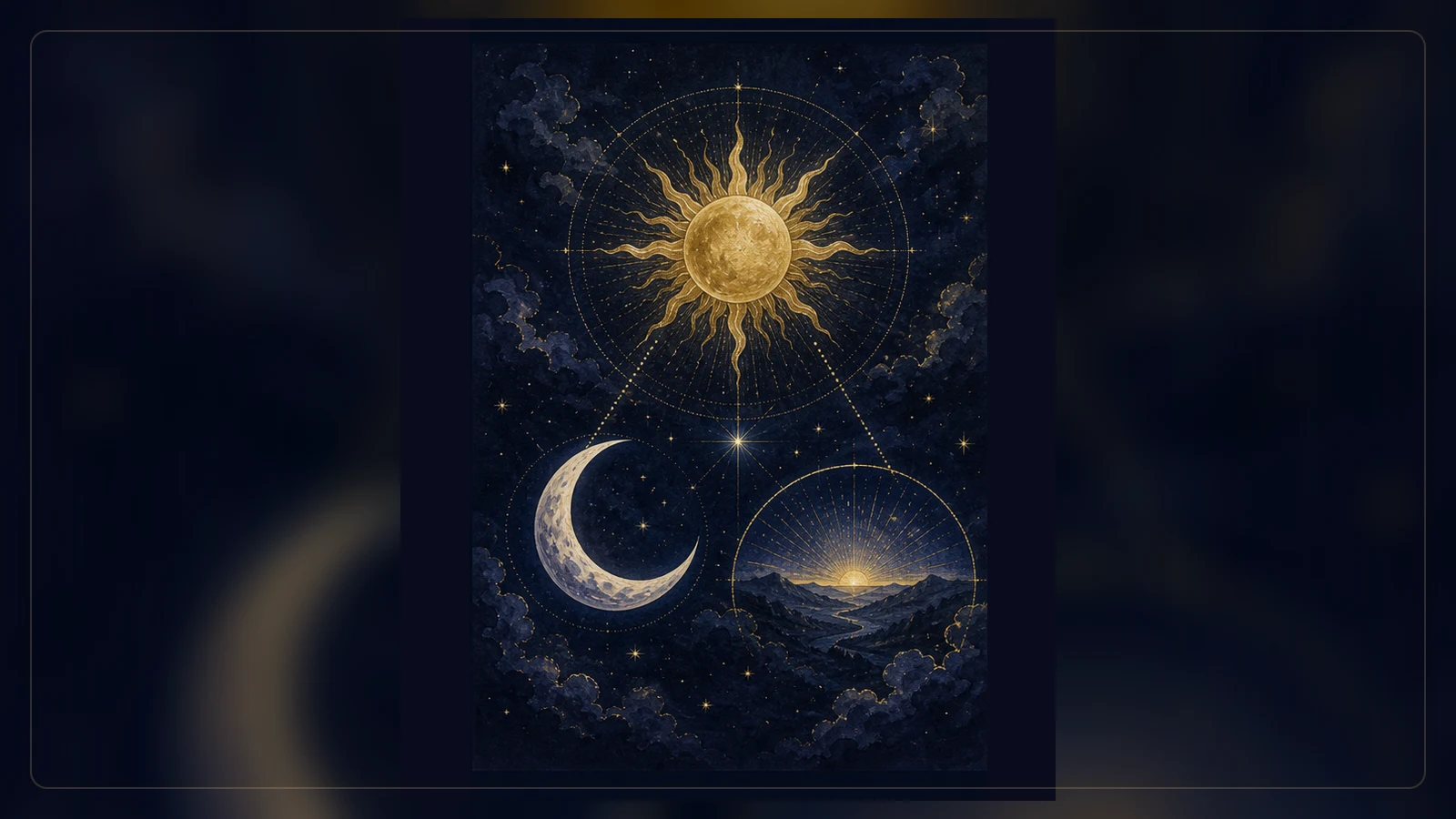
Ask someone their sign and you get one word back — the Sun sign, the one from birthday columns. It is genuine information. It is also one third of the headline. Astrologers open a chart with three placements, not one: the Sun, the Moon and the rising sign, together known as the big three.
They earn the billing because they answer three different questions: what drives you, what restores you, and how you arrive in a room. Here is each one in plain English — and what happens when they disagree, which is most people, and the interesting part.
Three placements, three different questions
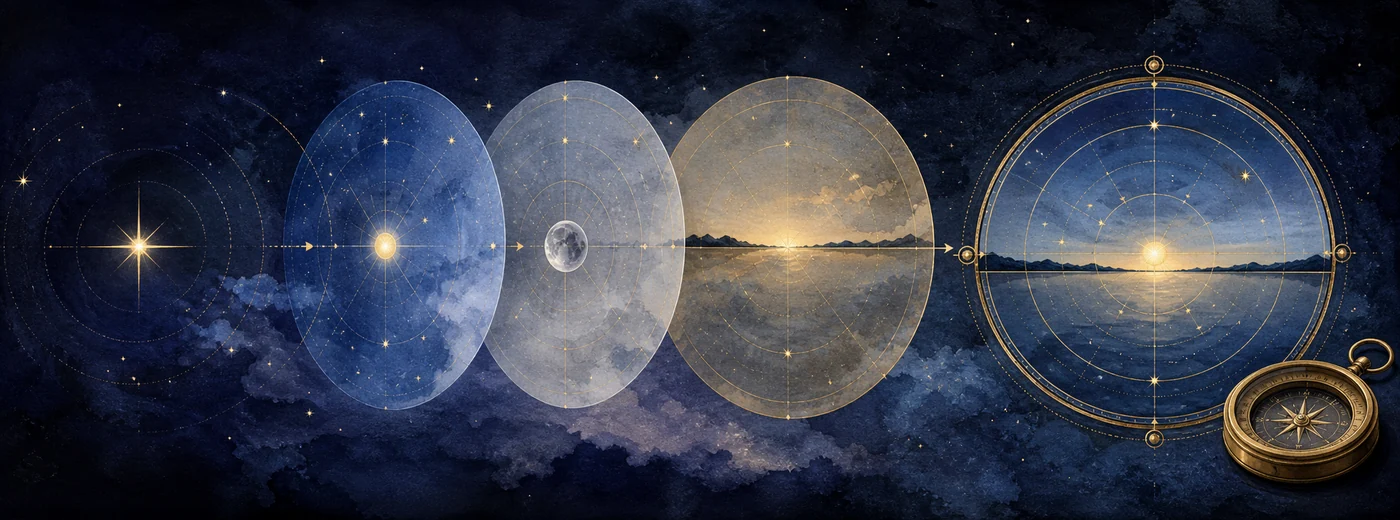
The three are not flavours of one thing; they run on different clocks and answer different questions. The Sun is identity — the through-line, what your life keeps trying to be about. The Moon is the inner room — needs, moods, what safety feels like from the inside. The rising sign is the doorway — the manner strangers meet before anyone has earned the deeper layers.
A shorthand that holds up: the Sun is what you are building, the Moon is what you are protecting, the rising is what you are wearing. All three are always on — which is why being handed just one of them and told "this is you" so often feels like being described by a stranger.
The Sun: the engine
Your Sun sign describes the core project of a personality — not the mood of a given Tuesday, but the direction you grow in when you get light and room. It is where vitality comes from and where pride is stored. A Leo Sun warms up the moment there is a stage, however small: hand them the toast at a birthday dinner and watch the battery refill in real time. A Virgo Sun refuels another way entirely — by being genuinely useful: the fixed spreadsheet, the streamlined system, the thing that finally works because they touched it.
The Sun spends about a month in each sign, so everyone born within weeks of you shares yours. That is worth holding on to: the Sun is the broadest stroke in the chart — the genre of the film, not the plot. True, and never the whole truth.
The Moon: the fuel
The Moon is the 11 p.m. placement: who you are when the performance ends, what you actually reach for after a day that scraped you. A Taurus Moon restores through the body — proper food, a heavy blanket, a series rewatched for the ninth time precisely because nothing in it will be a surprise. A Cancer Moon needs its people: the call home, the friend who knows the entire backstory. An Aquarius Moon needs air first — a step back, the feelings converted into thoughts before they can be safely felt.
None of this is visible from the outside, which is why the Moon runs so much of what happens in close relationships. Couples rarely clash Sun against Sun at breakfast; they clash because one Moon needs to talk it through tonight and the other needs the door shut until morning. The Moon also changes sign every two and a half days — it is the placement that most separates you from everyone else born your month.
The rising: the doorway
The rising sign — the Ascendant — is whichever sign was climbing the eastern horizon at the minute you were born. It is the chart's front door: the default manner, the face that does the interviews, the first read strangers get. A Capricorn rising walks in composed and faintly formal, and gets called serious by people who would not believe the nonsense their oldest friends know. A Sagittarius rising arrives mid-anecdote. A Pisces rising spends a lifetime being told they seem dreamy and somewhere else — whatever the Sun is busy doing underneath.
Because it is pinned to the turning horizon rather than to a planet, the Ascendant is the fastest-moving thing in a chart — a new sign roughly every two hours. That speed is why two people born the same day in the same city can read so differently at first meeting, and why astrologers ask for a birth time before they ask anything else.
The rising sign is also the honesty test of any reading. Date and place are easy; the Ascendant demands a time. If something claims to know yours without asking when you were born, it guessed.
How the three fit together
A way to hold all three at once: the rising is the door, the Sun is the house, the Moon is who actually lives there. People meet the door, get to know the house, and only the trusted meet the resident. When all three share a temperament, a person reads as exactly what they are, instantly. Most of us are not built that simply — and the gaps are where charts get good.
Take an Aries Sun with a Pisces Moon: an engine built for speed and confrontation, fuelled from a tank that floods with everyone else's feelings — the colleague who charges hardest in the meeting and replays one sentence from it at 2 a.m. Or a Libra Sun behind a Scorpio rising: a genuine peacemaker who reads as intense and unknowable, forever surprising people with how reasonable they turn out to be once the door opens. These tensions are not flaws in the reading. They are the reading.
They are also why "what is your sign?" undersells nearly everyone. One sign sorts humanity into twelve boxes. Three placements already allow 1,728 combinations — before Mercury, Venus, Mars or a single aspect has said a word. The Sun sign is true the way a headline is true. The big three are at least the opening paragraph.
Finding your three
The Sun asks only for your date — with one caveat: the changeover days shift slightly from year to year, so if you were born on one, the hour decides which side of the line you landed. The Moon asks for the date and, on some days, the time: it changes sign every couple of days, and if it moved during your birthday, the clock settles which Moon is yours. The rising is the demanding one — it needs the time, as exact as you can get it, and the place, because the horizon is local.
With those pieces of data, the big three are a five-minute job for a proper calculator — computed from the actual sky, not looked up in a table. A better answer to "what is your sign?" exists. It is just three words longer.
Find your Sun, Moon and rising — computed from your birth details, explained in plain English. The preview is free.