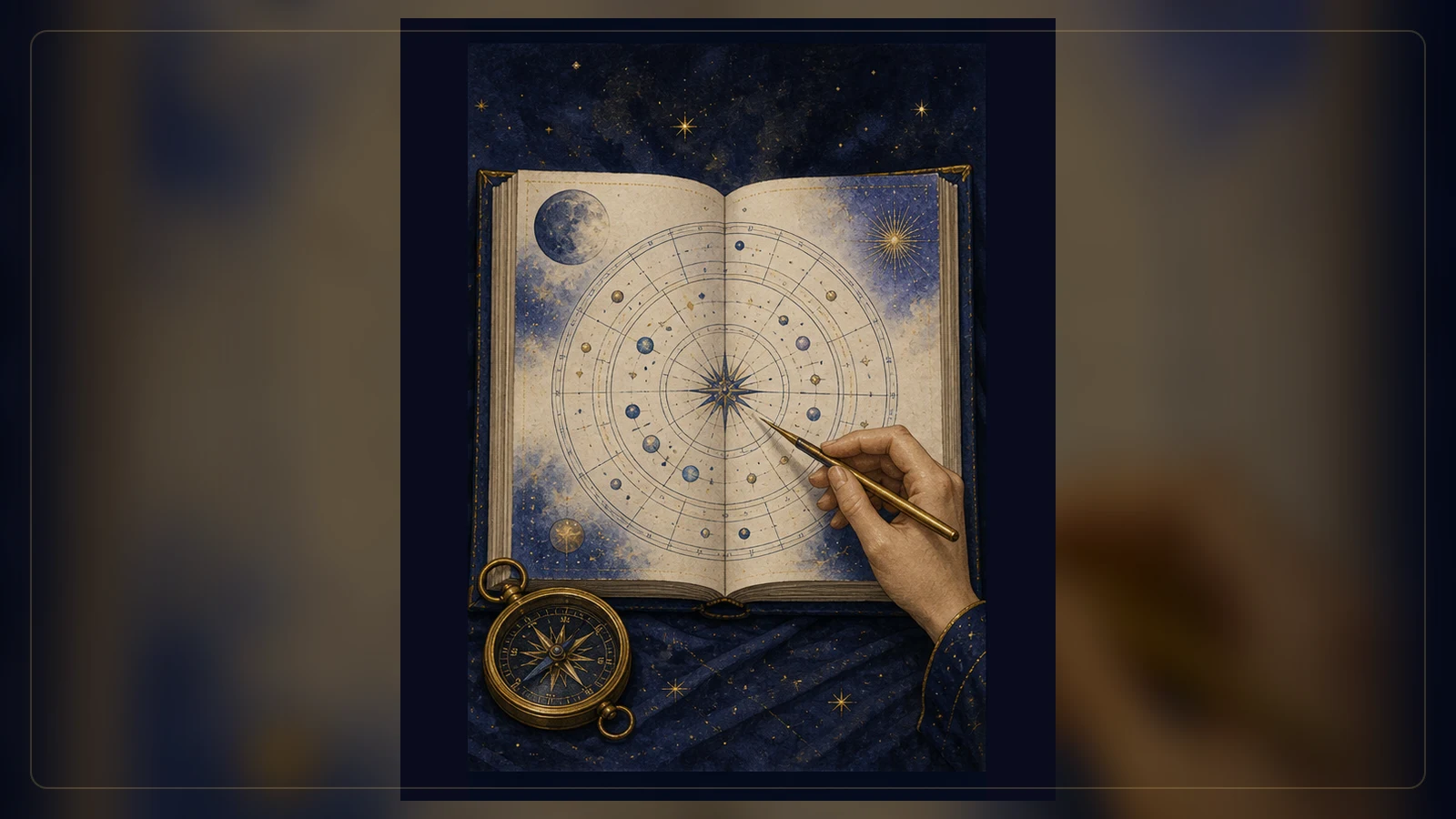
Open a birth chart for the first time and it looks like the cockpit of something you are not licensed to fly: a wheel, a ring of glyphs, coloured lines crossing the middle. None of it is decoration. A chart is a diagram of where the Sun, the Moon and the planets stood at the minute you were born, viewed from the place you were born. The drawing is astronomy. The meaning is a craft — and the craft has an order of operations.
This is a walkthrough of that order: what the chart actually is, which layers to read first, how the parts talk to each other, and — just as important — what no chart can tell you, no matter who reads it.
What a birth chart actually is
Strip away the mystique and a birth chart is a computed object. The positions come from an ephemeris — the tables of planetary motion that astronomy itself runs on — so your chart says Mars at 14° Scorpio because that is measurably where Mars was, from your town, at your minute. Two honest calculators fed the same birth data will agree to the degree. The fiddly part is not the planets but the clock: a chart needs the timezone rules as they stood on the day — summer time, wartime changes, borders that moved — which is why serious software keeps the historical ones.
The frame the positions are written in is the tropical zodiac: the Sun's yearly path divided into twelve equal segments of 30°, counted from the March equinox. The signs share names with constellations, but they are not the constellations — they are a coordinate grid pinned to the seasons. So when a headline announces that the constellations have drifted and your sign is therefore wrong, it is describing a different map. Your chart never used that map.
A calming habit: keep "is the chart true?" and "is the reading useful?" apart. The positions are astronomy and simply true. The interpretation is a craft — judge it the way you judge any description of you: by whether it is specific, honest and of practical use.
Read it in layers — and in this order
The classic beginner mistake is reading a chart like a buffet: a nibble of every placement until everything contradicts everything. Read it as layers instead, loudest first. The Sun — the engine of identity, what your life keeps trying to be about. Then the Moon — the emotional baseline, what you need as opposed to what you show. Then the rising sign, or Ascendant — the sign climbing the eastern horizon at your birth minute, which sets the manner people meet before they meet you.
Then the personal planets, the ones that make a chart yours rather than your birth month's. Mercury is how you think and speak. Venus is how you attach, and what you find beautiful. Mars is how you want, act and argue. These three move quickly enough that two people born weeks apart can differ across all of them.
Jupiter and Saturn paint in broader strokes: where you expand and say yes too easily, and where you doubt, delay and eventually build something that holds. The planets beyond Saturn move so slowly they describe generations more than individuals — a personal first reading can safely leave them for later.
Only then come the aspects — the geometry between planets — and the census of elements and modalities. Traditional practice adds houses on top, which demand an exact birth time. But the layers above are the load-bearing ones, and the order matters: big brush before small brush, mural before brushwork.
Aspects: how the parts talk to each other
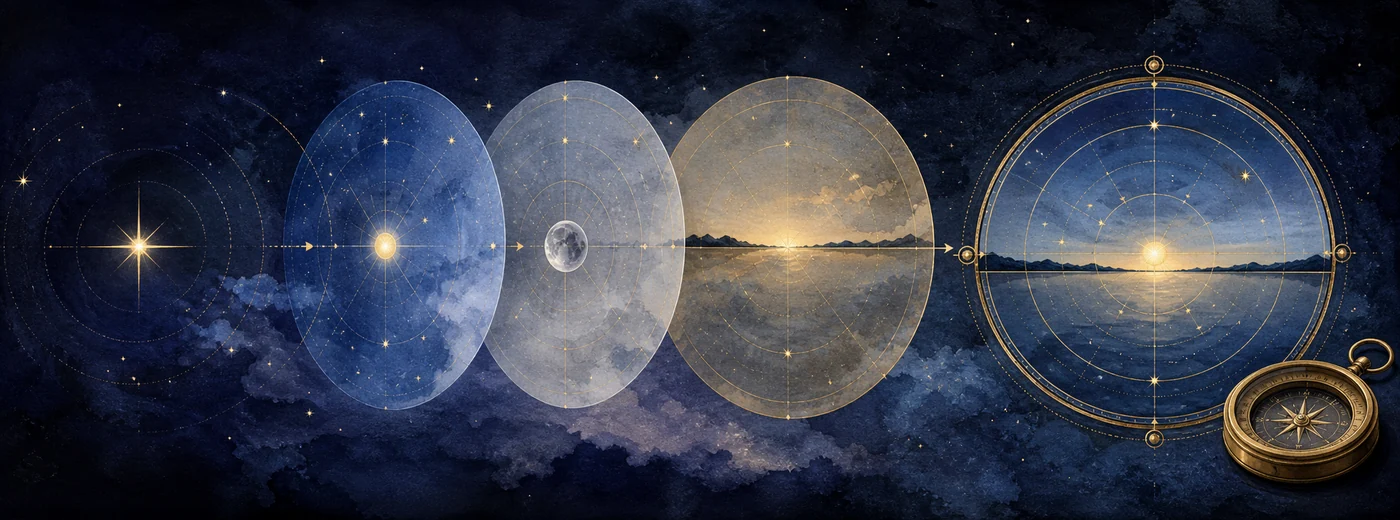
Planets sit at angles to one another around the wheel, and five of those angles carry most of the meaning. A conjunction (0°) fuses two planets into one loud signal — Mercury conjunct Mars thinks fast and argues faster. A sextile (60°) is an open door: easy cooperation, but only if you walk through it. A square (90°) is friction — two drives at right angles, neither willing to lose; squares are uncomfortable, and they are where most of the growing happens. A trine (120°) is flow, often so smooth the talent goes unnoticed by its owner. An opposition (180°) is a tug-of-war across the chart, usually lived as a balance you renegotiate for years.
No aspect has to be exact. Astrologers allow an orb — a few degrees of slack either side, commonly six to eight for the major aspects — and the tighter the orb, the louder the aspect speaks. A square exact to one degree organises years of a life; the same square at seven degrees is background hum.
If you check only one thing in your own chart, find its tightest aspect — smallest orb, any kind. Whatever those two planets are negotiating, you have been negotiating daily for as long as you can remember.
Elements and modalities: climate and gear
Every sign belongs to one element and one modality, and tallying your planets across them is the quickest honest summary a chart offers. The elements are climate — the kind of energy you run on. Fire (Aries, Leo, Sagittarius) runs on momentum and the next challenge. Earth (Taurus, Virgo, Capricorn) runs on the tangible: results, routines, things you can hold. Air (Gemini, Libra, Aquarius) runs on ideas and exchange. Water (Cancer, Scorpio, Pisces) runs on feeling and undercurrent.
The modalities are the gearbox — how you move through what the climate gives you. Cardinal signs (Aries, Cancer, Libra, Capricorn) start things. Fixed signs (Taurus, Leo, Scorpio, Aquarius) hold and finish them. Mutable signs (Gemini, Virgo, Sagittarius, Pisces) adapt and reroute. Nearly every chart is lopsided somewhere, and the lopsidedness is the reading: heavy fire with no earth launches five projects and invoices for none of them; heavy fixed with no cardinal will finish anything, provided someone else starts it. A missing element is not a defect — it is the part of life that costs deliberate effort instead of arriving free.
What a chart cannot do
A natal chart contains no events. There is no wedding in it, no diagnosis, no redundancy, no stranger arriving in October. Anyone who reads a fixed future out of a birth chart put it there themselves. What the chart describes is tendency and texture: how you charge and drain, where friction recurs, which trades come cheap to you and which cost double. Weather, not fate — and weather has never once made a decision on a person's behalf.
It cannot rank you, either. There are no good charts and no bad ones. An easy chart full of trines can coast into very little; a hard chart full of squares can practise itself into an extraordinary life. The chart deals a temperament. Circumstance, luck and ten thousand choices play the hand.
And it is not a verdict. Two babies born in the same ward in the same hour share a chart and will not share a biography. If a reading ever tells you what must happen — rather than what tends to be true of how you operate — you are no longer reading astrology. You are being sold certainty, which is the one thing the sky never offered.
Reading your own: a sane way to start
Start with data, not interpretation. Date, place, and the most exact birth time you can find — minutes matter for the rising sign, which changes every two hours or so. Then have the chart computed properly rather than eyeballed from a magazine table: the dates when the Sun changes sign shift slightly from year to year, and only computation catches the edge cases.
Then read in the order above — Sun, Moon, rising, Mercury, Venus, Mars, Jupiter, Saturn, tightest aspects, element count — one layer at a time, holding each lightly until something repeats. One placement is a sentence; three placements pointing the same way is a theme, and themes are what charts are for. Expect a few notes to land instantly, a few to take a decade, and one or two to feel flat wrong — every honest reader has those. You have been living in this weather all along. Reading the chart well just means you stop being surprised by your own sky.
See your own sky — get your chart computed from a real ephemeris and walked through in plain English. The preview is free.