It is the most common roadblock in astrology: you finally go looking for your birth time, and there is nothing. The certificate does not list one, the hospital has moved, and your mother remembers the weather that day better than the clock. The good news is blunt — most of a birth chart never needed the time.
Of the placements a natal chart is built on, the majority are fixed by the date alone. One goes blurry on certain days. Exactly one is genuinely lost. Here is the honest inventory — and where the missing hour sometimes turns up.
What survives on the date alone
Planets move at wildly different speeds, and that is what saves a time-less chart. The Sun travels about one degree a day and changes sign once a month, so unless you were born within hours of a boundary — roughly a one-in-thirty chance — your Sun sign is settled by the date. Mercury and Venus still spend weeks in each sign even at their fastest; Mars stays around six; Jupiter sits in one sign for about a year, Saturn for about two and a half. Against gaits like those, a single day of uncertainty almost never moves anything.
So the bulk of a first reading stands with no clock at all: identity (Sun), mind and voice (Mercury), attachment and taste (Venus), drive and temper (Mars), where you expand (Jupiter), where you tighten and build (Saturn). All six readable, all six solid. On the rare date one of them does cross a boundary, an honest calculator can see it in the ephemeris and say so — which is exactly the behaviour to look for in one.
The Moon: usually fine, sometimes a threshold
The Moon is the sprinter — about thirteen degrees a day, a new sign every two to two and a half days. On most birth dates it sits inside one sign from midnight to midnight, and your Moon sign is safe without a time. But roughly two days in five it crosses a boundary somewhere inside the day, and then the missing hour genuinely decides: born that morning, a Capricorn Moon; born after dinner, an Aquarius one.
If your date is one of those threshold days, read both candidates — not as a consolation prize, as a method. The Moon describes needs, and needs are recognisable from the inside in a way almost nothing else in a chart is.
Read both possible Moons and watch which one describes your late-evening self — what you reach for after a day that emptied you. One will sound politely plausible. The other will be slightly embarrassing in its accuracy. It is the embarrassing one.
What is genuinely lost: the rising sign and the houses
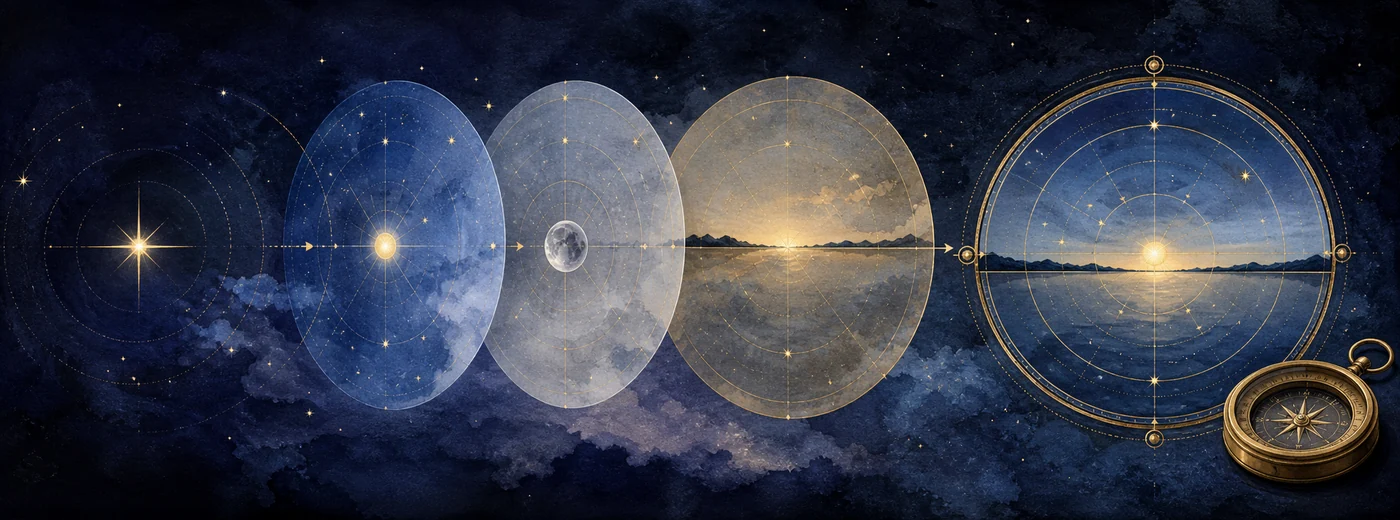
The Ascendant changes sign roughly every two hours and cycles through the entire zodiac every day, which makes it unrecoverable from a date alone. No time, no rising sign — and anyone who offers you one anyway is guessing. The houses go with it: the chart's division into areas of life is anchored to the Ascendant, so without a time there is no saying which part of the sky meant career for you and which meant home.
That is the real cost, and it is survivable. The planets in their signs — the psychology of the chart, the whole cast and their characters — never depended on the houses. You still know who is in the play. You are just not told which rooms they are standing in.
How to hunt down a birth time
Before settling for no time, exhaust the boring sources in order. The long-form birth certificate first: in many countries the full version records the hour even when the short extract does not, and registries will reissue it decades later. Rules vary — some countries record a time for every birth, others only for twins and multiples — so the question to ask is always for the fullest record that exists. Then the hospital: maternity records outlive expectations surprisingly often, and a written request to a records department sometimes comes back with the exact minute.
Then interrogate memory properly. "What time was I born?" earns a shrug; anchors do better. Was it light outside? Before breakfast or after? Did your father go to work that day, or get called away from it? What was on television? Which shift of nurses? A confident "early evening" cuts twelve possible rising signs down to two or three. And check the family paper — baby books, christening notes, a grandmother's diary. That generation wrote things down more than it talked.
Why noon is the honest convention
When the hour cannot be recovered, the convention is to compute the chart for 12:00 — a noon chart. It looks like a dodge and is the opposite: noon can never be more than twelve hours from the truth, so it caps every planet's error at half a day's motion. For the Sun, that is half a degree; for Saturn, almost nothing. Only the Moon carries real uncertainty — six or seven degrees — which is precisely why a careful noon reading flags the Moon on threshold days instead of bluffing through them.
A missing birth time shrinks a chart; it does not cancel it. Sun through Saturn stand. The Moon usually stands, and occasionally asks you a question instead of answering one. Only the rising keeps its secret — until a registry office, a records department or a well-anchored memory finally gives it up.
Have a date but no time? Compute what your chart can honestly say — the preview is free.